Known as the ‘garden city’, Bangalore offers a leafy backdrop from which to explore the bustling streets of India’s third largest city. Cosmopolitan restaurants line wide avenues where foodies can delight in a smorgasbord of south Indian flavours. Tea lovers can indulge in fragrant cups of Chai and a spell of people-watching from any of the tea stalls dotted around the city. A booming IT industry coupled with a city that seeks to preserve its green and colonial heritage has created a modern and sophisticated metropolis. Recently voted the most liveable city in India, Bangalore makes a great base for travelling southern India.
On arrival in Bangalore: Having cleared immigration, collected your luggage and passed through customs, please make your way towards the exit of the terminal building where you will meet your Travel Counsellors Representative who will take you to your hotel. Normal check in time at the Hotel is 1400 rs.
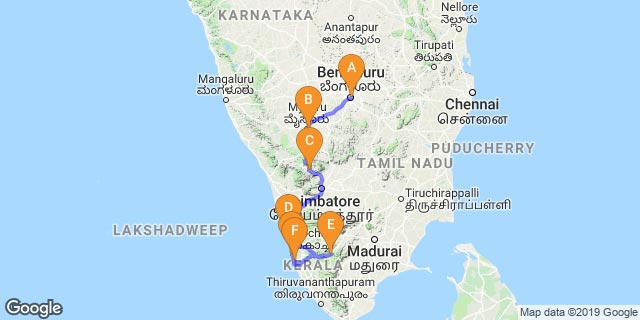
Day 2: Bangalore – Mysore
Serving as the capital of the Kingdom of Mysore from 1399 until 1947, the city of Mysore is a rich cultural and historical centre renowned for its beautiful Hindu palaces. Arguably the most captivating of these is the opulent Mysore Palace or Amba Vilas, particularly during the annual Dasara Festival, when every day after sunset it turns incandescent with the light of nearly 100 000 bulbs. In the modern context, Mysore is considered one of India’s cleanest and most efficiently planned cities, and has earned a reputation for its high quality sandalwood and silk.
Leave after breakfast with your private chauffeur driven vehicle to Mysore [Approx. 160 kms / 4 hrs] with a stop enroute at Srirangapatnam.
Srirangapatna
Srirangapatna alternatively known as Shrirangapattinam is a religious, cultural and historically significant town. This river island town’s name is sourced from the famous Ranganathaswamy Temple which dominates the town, and this temple resembles Hoysala and Vijayanagar architecture as it was restrengthened and modified after its initial construction in the 9th century.
On arrival at Mysore, check into your hotel.
Day 3: Mysore
Enjoy a walking tour Mysore followed by a tour of Mysore Palace and Chamundeshwari temple.
The walking tour starts with K.R circle & Small clock tower, followed with Devaraj Market, It is about more than a hundred year old market which has lot to be explore in and around.Coffee break at Hotel Dasaprakash, to experience the local people & food. Sayyaji Rao Road It is the local shopping street of the city with ongoing local trade.
Day 4: Mysore – Ooty
Resting in an amphitheatre amid the Nilgiri mountain range, Udhagamandalam, also called Ooty is a beautiful hill station surrounded by terraced rolling hills dotted with 19th-century tea plantations. Perched at an altitude of 2240 m above sea level, this misty mountain town once served as a summer retreat for the British elite who enjoyed its crisp cool climate. Known as the Queen of Hill Stations, the combination of scenic natural surrounds, Hindu temples and the Indian bustle make this a popular destination for visitors. Must-see attractions include: the Botanical Gardens, featuring ferns, orchids and a prehistoric fossilized tree; the Government Museum, showcasing the history of the Tamil Nadu region; and the Mudumalai Wildlife Sanctuary, recently declared a tiger reserve and a World Heritage Site.
Leave in the morning to Ooty. [Approx. 100 kms / 3 hrs]
Ooty now called Ootacamund, is the Queen of slope stations and the capital of Nilgiri region. It is situated in Nilgiri hills, also known as the Blue Mountains. Ooty served as the summer capital of Madras Presidency and other small kingdoms. The place was much visited by British during the colonial days. Lofty mountains, great lakes, dense forests, sprawling grasslands, miles of tea gardens and eucalyptus trees greet the travelers. The hill station itself is a land of picturesque picnic spots.
Day 5: Ooty
Enjoy a toy train ride to Coonoor roday. Later in the day do a tour of the Botanical Gardens and St. Stephens Church.
Divided into several sections, the boatanical garden, cover an area of around 22 hectares, and lie on the lower slopes of Doddabetta peak. The garden has a terraced layout. It is maintained by the Tamil Nadu Horticulture Department. Its architect was William Graham McIvor. The Marquis of Tweedale prepared the initial layout during the late 1840s. During that time Ootacamund (Ooty) was under British control. The Gardens have around a thousand species, both exotic and indigenous, of plants, shrubs, ferns, trees, herbal and bonsai plants. In the centre of the Gardens lie a fossilized tree trunk estimated to be 20 million years old.
The St. Stephen’s Church in Ooty is indeed a marvellous and breathtaking architectural marvel that the British left for us after they finally gave us our independence. The Church is one of the earliest churches that you will find in the Nilgiris district. The structure dates back to the 19th century and was built by the British government. The date of the commencement of construction was cleverly chosen to coincide with the birthday of King George IV. The fabulous pale-yellow building of the St Stephen’s Church bears testimony to the marvels of British architecture that existed during those times. This grandeur is also reflected in the painting of ‘The Last Supper’ that can be found in the Church.
Day 6: Ooty – Cochin
Also known as Cochin, Kochi is a city in southwest India’s coastal Kerala state. This attractive city has served as a popular port for over 600 years and is known for its eclectic architecture and its array of religious monuments, museums, galleries, cafes and antique shops. The city stretches across a number of peninsulas and islands, which can be reached by a network of water taxis and bridges. The majority of Kochi’s visitor highlights can be found on the peninsula of Fort Kochi. These highlights include the St Francis Church, the oldest European-built church in India; and Mattancherry Palace, which dates back to 1557 and contains some exceptional Kerala murals and temple art. Other must-see attractions include the Kerala Folklore Museum, displaying more than 4,000 cultural and ethnic artifacts; the 16th-century Jewish Synagogue; and the local market, where the air is filled with the aroma of exotic spices.
Leave after breakfast with your private cheauffeur driven vehicle to Kochi [Approx. 6 hrs]. Arrive and check-in at the hotel. Rest of the day is at leisure.
Day 7: Cochin
Today proceed for half day sightseeing tour of Cochin. The tour allows you to explore the charming fort Cochin, Jewish Synagogue (Closed on Fridays & Saturdays), Dutch Palace (closed on Thursdays & Fridays), Jew Town, and St Francis church.
The Dutch Palace is a beautiful palace that was originally built by the Portuguese. It was only during the 17th century that the Dutch took it over, modified it and then presented it to the Raja of Kochi. The main attractions here are the outstanding collection of mural paintings found inside. These murals beautifully depict scenes from the Hindu epics of Mahabharatha and Ramayana.
The St. Francis Church [Closed on Sundays] is the oldest church in India to have been built by the Europeans. The famous Portuguese trader Vasco da Gamais well known for reaching India from Europe by sea instead of by the usual overland route. The church is famous for being the initial burial place for Vasco Da Gama.
Later in the evening enjoy Kathakali – the traditional dance drama of Kerala, it dates from the 17th century and is rooted in Hindu mythology. Kathakali is one of the most complicated, highly stylized Indian art form that is basically a Dance Drama noted for its heavy and attractive larger than life make up, elaborate costumes, detailed body movements, synchronized eye-hands movements and thematic presentation of stories with rhythmic steps.
Day 8: Cochin – Thekkady
A tourist attraction in Kerala, Thekkady is a district located at the Periyar National Park. Thekkady comprises evergreen forests and savanna grasslands, and is known for its natural spices such as black pepper, cardamom, cinnamon, nutmeg, ginger and clove. Elephants, tigers, sambar and many other species inhabit the park. Top attractions include the exquisite ancient Mangla Devi Temple, the aromatic Abraham’s spice garden, and the massive waterfall at the sleepy, picturesque village of Chellarkovil. Take in panoramic views of the extraordinary landscape from the Chellarkovil viewpoint, and picnic on the rolling, lush green lawns at Pandikuzhi. Don’t miss the opportunity to visit the Kadathanadan Kalari Centre, to see demonstrations of the best traditional martial arts. Thekaddy is home to India’s sole Tiger Reserve, and has a rich living tribal culture.
This day you will be driven to Periyar by your private vehicle [Approx 4 Hrs.]
The Periyar Wildlife Sanctuary is situated on the banks of the Periyar Lake – an artificial lake, at Thekkady. Here the high ranges of the Western Ghats are clothed in dense evergreen, moist deciduous forests and savannah grasslands. Periyar is famous for its rich wild life and spice plantation.
Rest of the day at leisure.
Day 9: Thekkady
This day proceed for a Nature walk at Periyar National park.
Different nature trails traversing diverse habitats form the trekking routes, generally 4 to 5 km. in length. This is an interpretive program offering excellent opportunity to watch birds, butterflies and other wildlife. The trails often pass through evergreen and moist deciduous forests interspersed with marshy grasslands. The program is offered between 7.00 am and 10.30 am and between 2.00 pm. and 3.00 pm. and lasts for about 3 hours. A maximum of 5 persons can go for trekking at a time along each nature trail, accompanied by a trained tribal guide. The Nature walk is the right program to feel nature, hear her whispers and smell her flowers.
Return to the hotel for breakfast.
Later in the afternoon, visit the Spice Plantation. Gift wrapped in lush green spice plantations, Periyar is the heartland of spices. The trip covers spice plantations such as cardamom, pepper, vanilla, clove, cinnamon, nutmeg, ayurvedic herbs etc. Over twelve varieties of spices including ginger, garlic, cardamom, vannilla, pepper, cinnamon, coffee, tea, clove and nutmeg is cultivated in Thekkady and its neighbouring villages.
Day 10: Thekkady – Alleppey
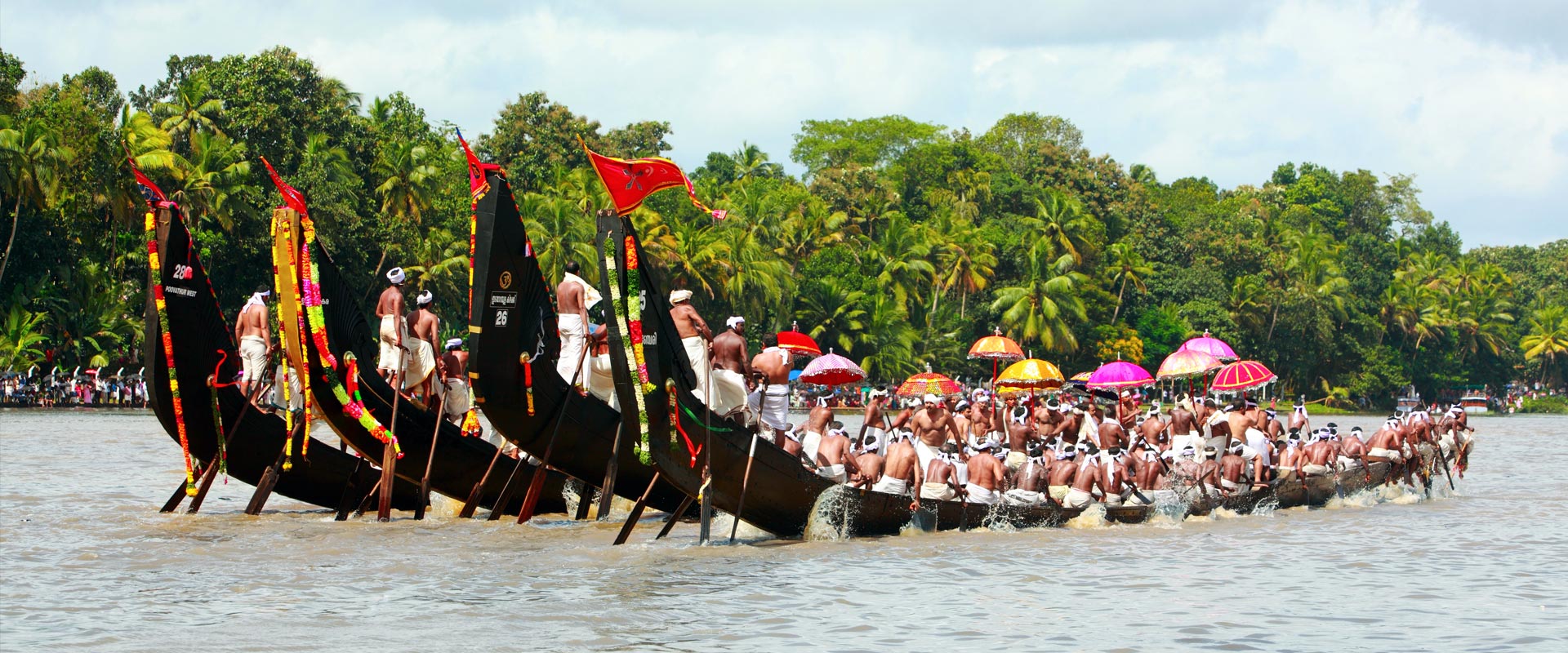
Alappuzha, also known as Alleppey, is set along the coast of the Laccadive Sea. Dubbed the ‘Venice of the East’, it is renowned for its houseboat cruises which float along the tranquil backwater canals of Kerala. It is said to be one of the most popular tourist centres in the state. While cruising the palm-shaded canals is the main attraction, visitors can also enjoy visiting Alappuzha’s beautiful beaches, exploring the little riverside villages dotting the lush countryside and discovering an array of resplendent temples. Don’t miss the annual Nehru Trophy Boat Race held at Punnamada Lake.
This day drive to Alleppey [Approx. 135 Km – 4 Hrs.] to arrive and board the Houseboat at 12:30 for a cruise over the backwaters of Kerala.
Cruise is followed by lunch at houseboat. These houseboats or Kettuvallam as they are traditionally called were at one time the mode of transportation for man and goods. Today, these are made to cater to the discerning guests who can lay back and enjoy the gentle cruise. Cruise the backwaters from the main Vembanad Lake through the small estuaries that link small villages to the mainland. Today, these are refurbished and all modern conveniences have been added for tourists who visit this beautiful water locked region of the country.
Day 11: Alleppey – Mararikulam
Situated only 40 km from the city of Cochin, in the Alappuzha district, Mararikulam is a charming little coastal village known for its pristine sand beaches, swinging coconut palms and quiet, laidback atmosphere. The village has managed to avoid the mass development associated with many of the other beach towns in the area resulting in an untouched natural environment dotted with only a handful of small resorts. The main attraction in the area is the exquisite Marari beach where you will find fishermen heading out daily to fish the waters of this stretch of the Malabar coast, much as their ancestors have done for generations.
Disembark the the boat and then leave for Mararikulam (Approx 30 minutes.)
Arrive Marari and you will be transferred to your hotel.
Day 12 – 13: Mararikulam
Days are at leisure at the resort. Option to take yoga/meditations, visit to the fishermans village, fishlanding, cycling through the village or to rejuvenate with some spa/ayurveda massages !
Day 14: Mararikulam – Cochin Depart
At an appropriate time, your Travel Counsellor Representative will assist and provide you the necessary transfer to the international airport.