Places Visited Amritsar – Hoshiarpur – Dharamsala – Pragpur – Shimla - New Delhi Tour Id : IN-16
Itinerary Overview
This journey covers travel to northern region of India covering Amritsar- the Holy city for Sikh religion and to Dharamsala – the seat of Dalai Lama in India.
Fly into Amritsar where you will be met by your Travel Counsellors Representative who will transfer you to your hotel.
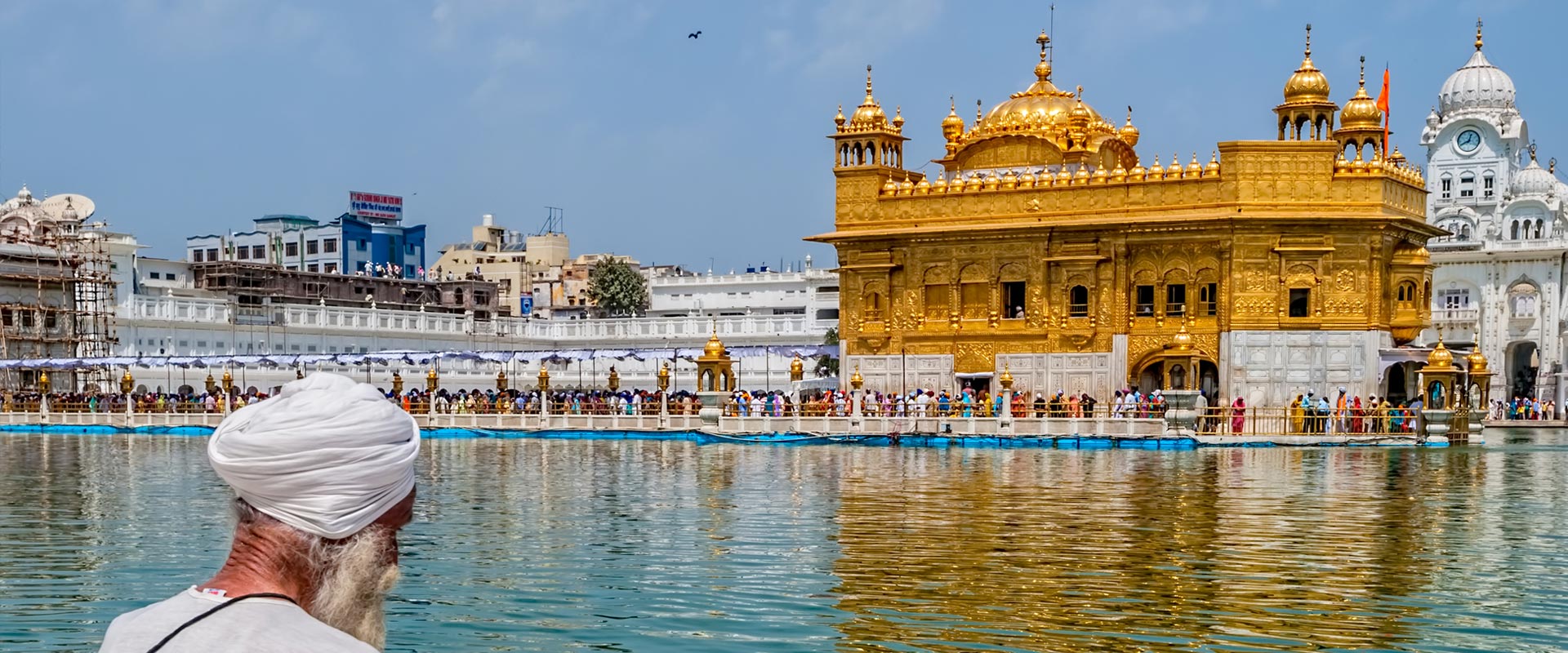
Evening witness Palki ceremony at Golden Temple.
Evening witness Palki ceremony at Golden Temple
Considered one of the most beautiful temples in the world – and the veritable heart of the Sikh religion – it’s no wonder that tourists come from all over the globe to see the Golden Temple of Amritsar. Situated in the middle of a sacred lake fed by an underground spring, the golden structure is a unique blend of Hindu and Muslim architectural styles. Within the temple is the Adi Grantha, the sacred scripture of the Sikhs, displayed on a jewel-studded platform. The best time to visit the Golden Temple of Amritsar is actually at night, when the Palki Sahib ceremony takes place. Dozens of devotee’s act as a human conveyor belt to carry the Granth Sahib (a shrine containing the Adi Grantha) from the main shrine to the sanctum, where it is kept until the opening ceremony the following morning. Visitors may participate in the ceremony, taking their turn to shoulder the weight of the enormous shrine.
Day 2: In Amritsar
Day Itinerary
After breakfast, enjoy a half day sightseeing tour of Amritsar city.
The Golden Temple
The Golden Temple Amritsar India (Sri Harimandir Sahib Amritsar) is not only a central religious place of the Sikhs, but also a symbol of human brotherhood and equality. Everybody, irrespective of cast, creed or race can seek spiritual solace and religious fulfilment without any hindrance. It also represents the distinct identity, glory and heritage of the Sikhs. To pen-down the philosophy, ideology, the inner and outer beauty, as well as the historical legacy of Sri Harimandir Sahib is a momentous task. It is a matter of experience rather than of description.
Take part Guru Ka Langar (Langar Hall): Community Kitchen
Everyone is welcomed to share the Langar; no one is turned away. Each week a family or several families volunteer to provide and prepare the Langar. This is very generous, as there may be several hundred people to feed, and caterers are not allowed. All the preparation, the cooking and the washing-up is done by volunteers and or by voluntary helpers (Sewadars). In the Golden Temple Community Kitchen at an average 75,000 devotees or tourists take langar in the Community Kitchen daily; but the number becomes almost double on special occasions. On average 100 Quintal Wheat Flour, 25 Quintal Cereals, 10 Quintal Rice, 5000 Ltr Milk, 10 Quintal Sugar, 5 Quintal Pure Ghee is used a day. Nearly 100 LPG Gas Cylinders are used to prepare the meals. 100’s of employees and devotees render their services to the kitchen.
The Jallianwala Bagh Garden
The Jallianwala Bagh Garden is a fenced garden with several entrances, located in Amritsar, India. This public garden is home to a national memorial, which serves as a lasting tribute to an innocent crowd of peaceful celebrators who lost their lives during a massacre by the British army. Today, the garden is mostly visited by tourists to learn about the killings and to admire the vast greenery or simply for relaxation and meditation.
Wagah Border
The Wagah Border links the towns of Amritsar in India and Punjab in Pakistan. The border serves as a transit point for goods and commuters between India and Pakistan and plays host to the daily lowering of the flag ceremony performed by the Border Security Force of India and the Pakistan Rangers in Pakistan. This ceremony commemorates the unity and cooperation between the two nations who were once rivals.
Day 3: Amritsar- Hoshiarpur
Situated in the northeast of the Indian state of Punjab, the city of Hoshiarpur lies in the upland region near the Outer Himalayas. Hoshiarpur is surrounded by the Shivalik Hills and sandwiched between the Vyas and Sutlej rivers. It boasts a colourful culture, a fascinating history and a host of archaeological remnants. This city is a major hub for transport and industry in the region including oilseed pressing and silk weaving. After breakfast you will be driven to Hoshiarpur. (approx 120 kms/ 03 hours drive)
Afternoon proceed for a guided walk through the farm and even join us picking some fruit during the season (November through February).
In the evening enjoy culinary tours, learn how to cook traditional Punjabi Food with our home made traditional family recipes.
Day 4: Hoshiarpur- Dharamshala
Situated in the upper reaches of the Kangra Valley, Dharamsala is one of Himal Pradesh’s most irresistible destinations. Famous as the home of the exiled Dalai Lama, this small market town is the centre of the Tibetan world in India. Most travellers head 10 kilometres uphill to the suburb of McLeod Ganj, also known as Upper Dharamsala. Surrounded by dense coniferous forest, this beautiful hill station attracts Buddhists, pilgrims, students and bohemian travellers seeking spiritual enlightenment and a possible encounter with this holy man. A worthwhile one-day trek, about nine kilometres from McLeod Ganj, is Triund Hill, described as heaven on earth for nature lovers.
Moring enjoy village safari to see the rural settings and experience a Punjabi lifestyle.
Later drive to Dharamshala, upon arrival check-in at hotel. (approx. 245 kms / 5 hours drive)
Day 5: In Dharamshala
Breakfast at the hotel. Enjoy half day sightseeing tour of Dharamshala.
Norbulingka Institute
Norbulingka Institute is a unique institute dedicated to the preservation of Tibetan arts and culture. The institute is a self-sustaining community located in Dharamsala, India. It is dedicated to ensuring that the integrity of Tibetan artistic traditions is maintained for future generations. The studios produce museum quality artwork using methods that have been practiced and passed down for many centuries.
Tsug la Khang, The Dalai Lama’s temple
This is the life-blood of the village. It houses the Namgyal Monastery and shrine rooms. The largest shrine contains a huge gilded statue of the Buddha, along with two smaller statues of Chenresig and Guru Rinpoche. Parts of these statues were brought at great sacrifice from Tibet. The Dalai Lama’s residence and administrative offices are adjacent to the monastery. The temple is always busy. Services are held daily and are attended by lamas, monks, nuns and lay people. In the shrine, you might come across a group of monks building an intricate sand mandala, and outside in the courtyard on Thursdays, monks debate Buddhist philosophy. Around the temple hill there is a long meditation trail — LingKhor — with small shrines, stupas, and a massive chorten. The shrines near the chorten are always covered in thousands of prayer flags placed by devotees. The temple is located a short walk down the hill from the main square at the centre of town.
St. John’s Church [Closed on Sundays]
Immerse in the composure of nature and a church amidst its greenest foliage! St. John’s Church is the most ancient structure of the town and it is a gothic stone shrine amidst the forest in between Mcleod Ganj and Forsyth Ganj. It is an Anglican structure that is a tribute to John the Baptist. ‘St. John in the Wilderness’ is no more a hidden entity.
Day 6: Dharamshala- Pragpur
The charming heritage village of Pragpur can be found in the beautiful Kangra Valley in Himachal Pradesh. With its cobblestone alleyways, mud plastered and slate roofed houses, and its array of historically significant sites, a visit to Pragpur feels like a journey back in time. The village’s most popular tourist attraction is ‘The Taal’, a pond located in the heart of the village which serves as a recreational space. It was constructed by the village brotherhood, which has maintained this ancient water system since the mid-1800s. The Taal is surrounded by many fascinating heritage structures including, among others: the Bhutail Niwas, the Radha Krishna Mandir and Nehar Bhawan. Don’t miss the Judge’s Court, a grand manor showcasing the Indo-European style of architecture..
Following breakfast drive to Pragpur (approx. 65 Kms / 2 Hrous drive)
The Kangra Valley, where Heritage Village Pragpur is located, is panoramic and replete with history. It is the home of the famous Kangra School of painting and probably the world’s – most certainly India’s – oldest ruling lineage comes from here.
Evening proceed for a village walk.
Day 7: Pragpur- Shimla
Shimla, lying deep in the foothills of the Himalayas, is the capital city of Himachal Pradesh and the gateway into the more remote northern regions of Kashmir. It is also the stop-off for travellers venturing into the Kullu and Spiti Valleys. Sitting at an altitude of 2159 metres, the city is blessed with a cool climate and beautiful views of river valleys, pine forests, apple orchards and steep mountains covered with maize terraces. The Mall, a long, winding pedestrian-only walkway, is the commercial and social hub of Shimla, while those looking for natural beauty should head uphill through the forest to Jakhu Temple or follow one of the many forest trails in the eastern part of Shimla. To the south of the city, the bazaars bustle with local flavour.
After breakfast you will be driven to Shimla (approx 200 kms/ 4 hours drive)
Day 8: In Shimla
Morning proceed for Short Toy Train ride from Shimla to Tara Devi (45 minutes ride)
Later enjoy half day sightseeing tour of Shimla.
Indian Institute of Advanced Study
Also called the Viceregal Lodge, the Indian Institute of Advanced Study is a research institute set in a historical building in Shimla. As a residential centre for research, it encourages creative thinking in areas of deep human significance. The environment of the institute is eminently suitable for academic pursuits, especially in select areas of the humanities, Indian culture, religion and the social and natural sciences. It also has a comprehensive library and documentation facilities.
Sankat Mochan Temple
Next, you will be visiting Sankat Mochan Temple. A famous temple of Lord Hanuman in the region is located amidst the mist-clad mountains, providing a serene and scenic environs, making visitors get lost in the mesmerizing atmosphere of the place. The temple was built in the decade of 1960s. It was a famous religious person Baba Neeb Karoriji Maharaj who gave the idea of building this famous Sankat Mochan Mandir. Originally dedicated to Lord Hanuman, the temple now also bears the idols of Lord Rama, Lord Shiva, and Lord Ganesha in various complexes.
Visit Shimla Mall Road
The Mall Road is one of the most popular tourist attractions in Shimla that enfolds many hotels, restaurants, clubs, bars, banks, shops, offices, post offices, and tourist offices. People can walk up and down the Mall road slowly and enjoy the scenic views of the nature while sipping their favourite coffee. A lot of people gather at the Ridge and Scandal point on Mall road to meet and talk with friends, see the views of the Himalayan range and to do some shopping. The Mall road is connected to the Ridge at the Scandal point, where a statue of the nationalist leader Lala Lajpat Rai has been erected.
Day 9: Shimla
Spend rest of the day at leisure.
Day 10: Shimla- Chandigarh- Delhi
After breakfast you will be driven to Chandigarh airport (approx 110 kms/ 4 hours drive) to board the flight for Delhi.
Upon arrival at Delhi, you will be assisted & transferred to the hotel for check in.
Day 11: Delhi Departure
At an appropriate time, you will be assisted & transferred to Delhi airport to board the flight for onward journey.